Building with AI: A PUBLISHING AGENT
My favourite kind of design work is the kind that ends up running without me. Build the system well enough that it holds on its own, and it frees me to go after the next, bigger problem. This was an experiment in taking that as far as I could alone.
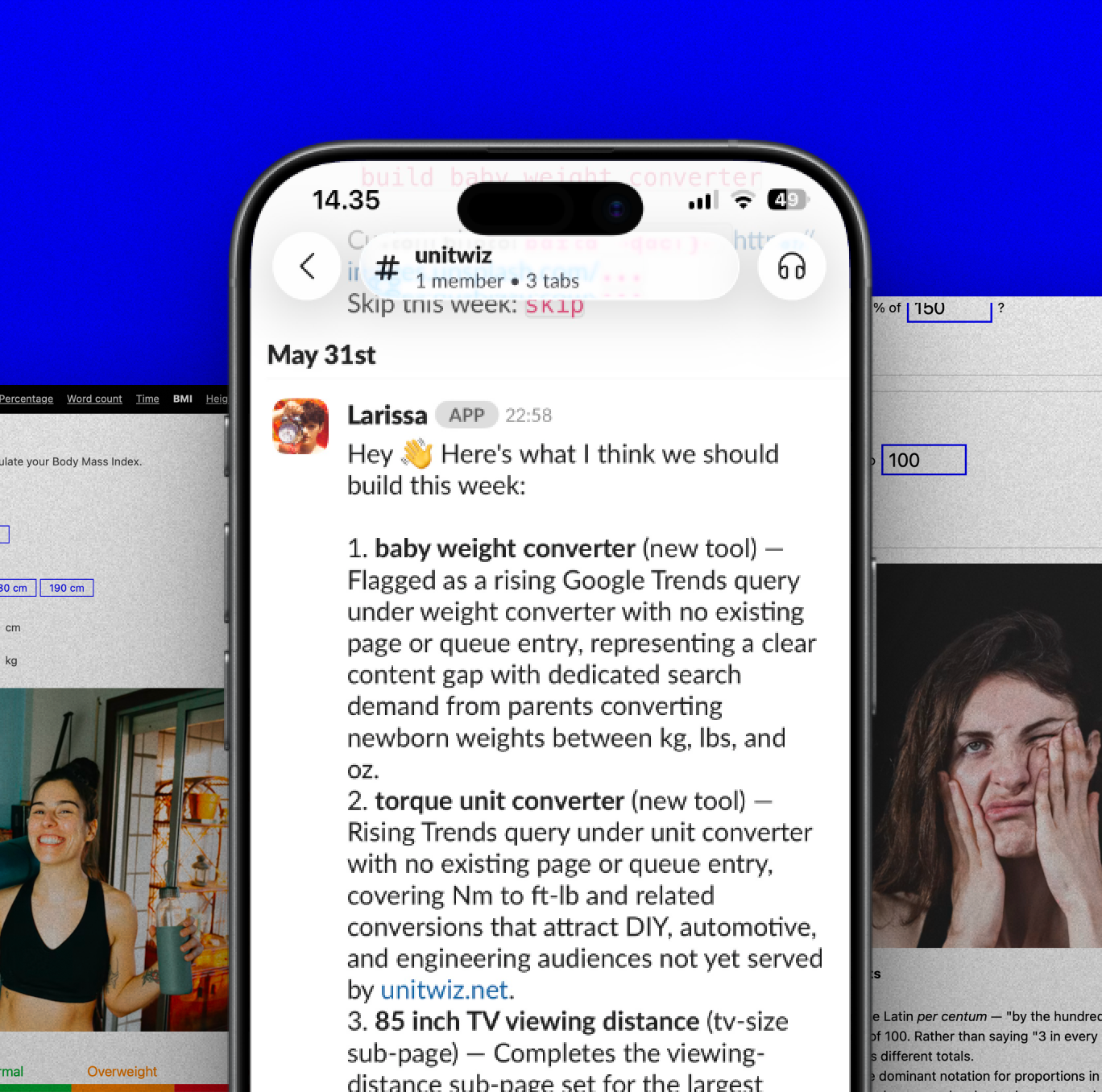
Every Sunday night, a Slack bot named Larissa told me what to build. She'd done her homework over the weekend, looked at the search data, and come back with three options and a short argument for each. Monday morning I'd read them, and reply with a single word.
“/build”
And then she’d get to work. New calculators written, illustrated, published, with the documentation and the roadmap updated to match. I hadn't done any production work. I'd approved a suggestion from a piece of software that had decided, on its own, what was worth doing.
That inversion is the whole project. For most of my career the direction of work ran one way: I decided what to make, then made it. Here the agent did the deciding. I just had to say yes. The agentic loop ran itself. The single word was mostly there so I stayed in control of what got spent, on tokens and on time.
Why build it at all?
My design approach has always aimed at the same thing: build the systems, the thinking and the culture solidly enough that the work keeps standing without me holding it up. Not so I'm not needed, but so I'm freed up for the bigger problems. Can I make it work that well? Maybe not a great career plan, but an admirable aspiration.
It's design-as-a-service, taken to a logical end. My output is never the screens. My output is the framework and the tools that enables the rest of the organisation to make flows, screens and experiences work. This experiment extends that thinking to a scale where I can carry out the whole project on my own and still have it mean something.
The experiment was to push the research, the prioritisation and the production all out of my hands, and find out what was left. What was left was judgment.
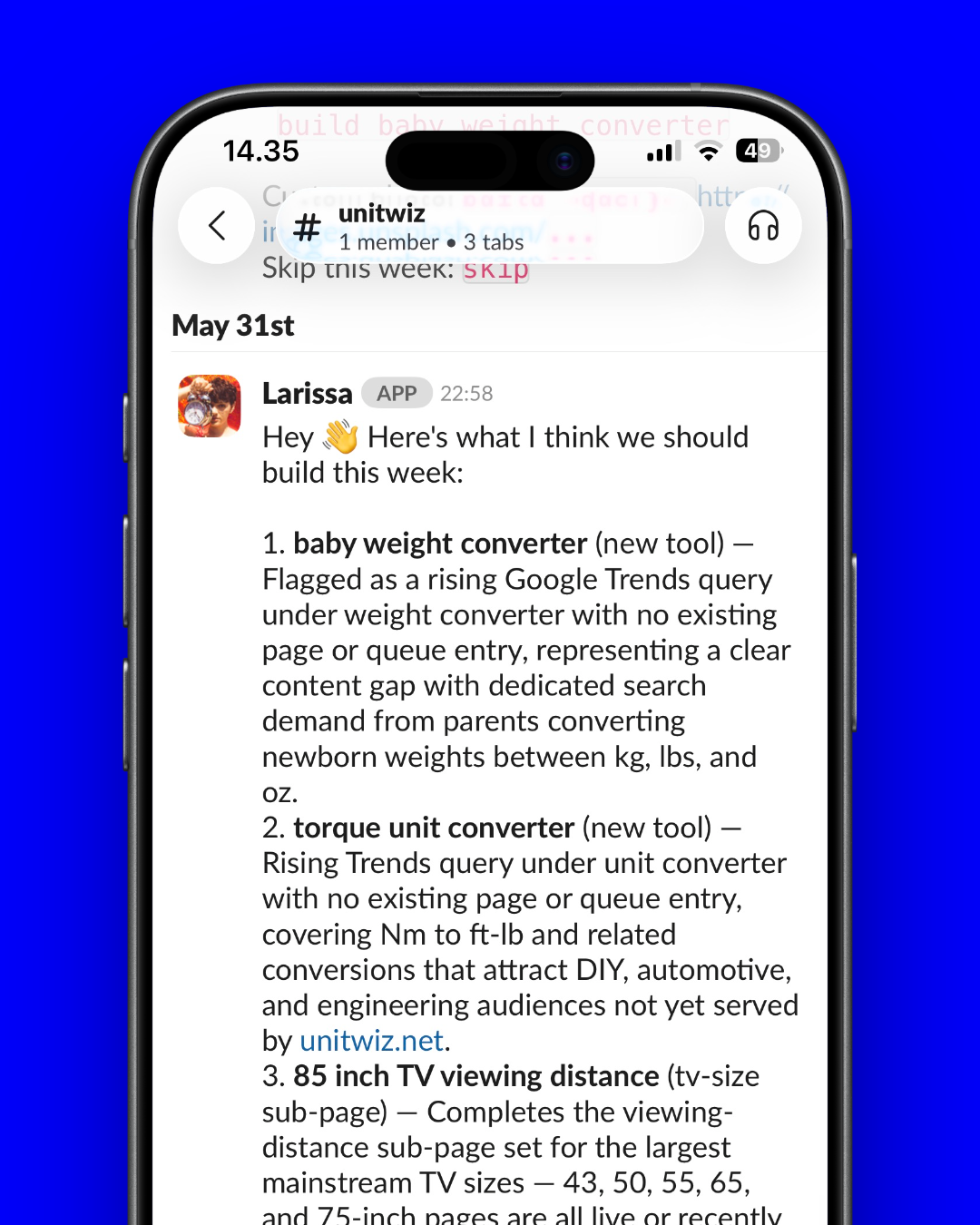
This is the full build-flow - from outside the machine room. I post in Slack during the week when I stumble on something that either was annoying (e.g. “I don’t get the US cup system in recipes”) or something that looks like a good idea or has market potential. Trying to mimick a reality, Larissa of course has a roadmap, she pairs the requests and mindless braindumps from the week gone by with simple trend research, and a look in Google Search Console data for the site to see if anything particular is rising.
It's just ugly calculators
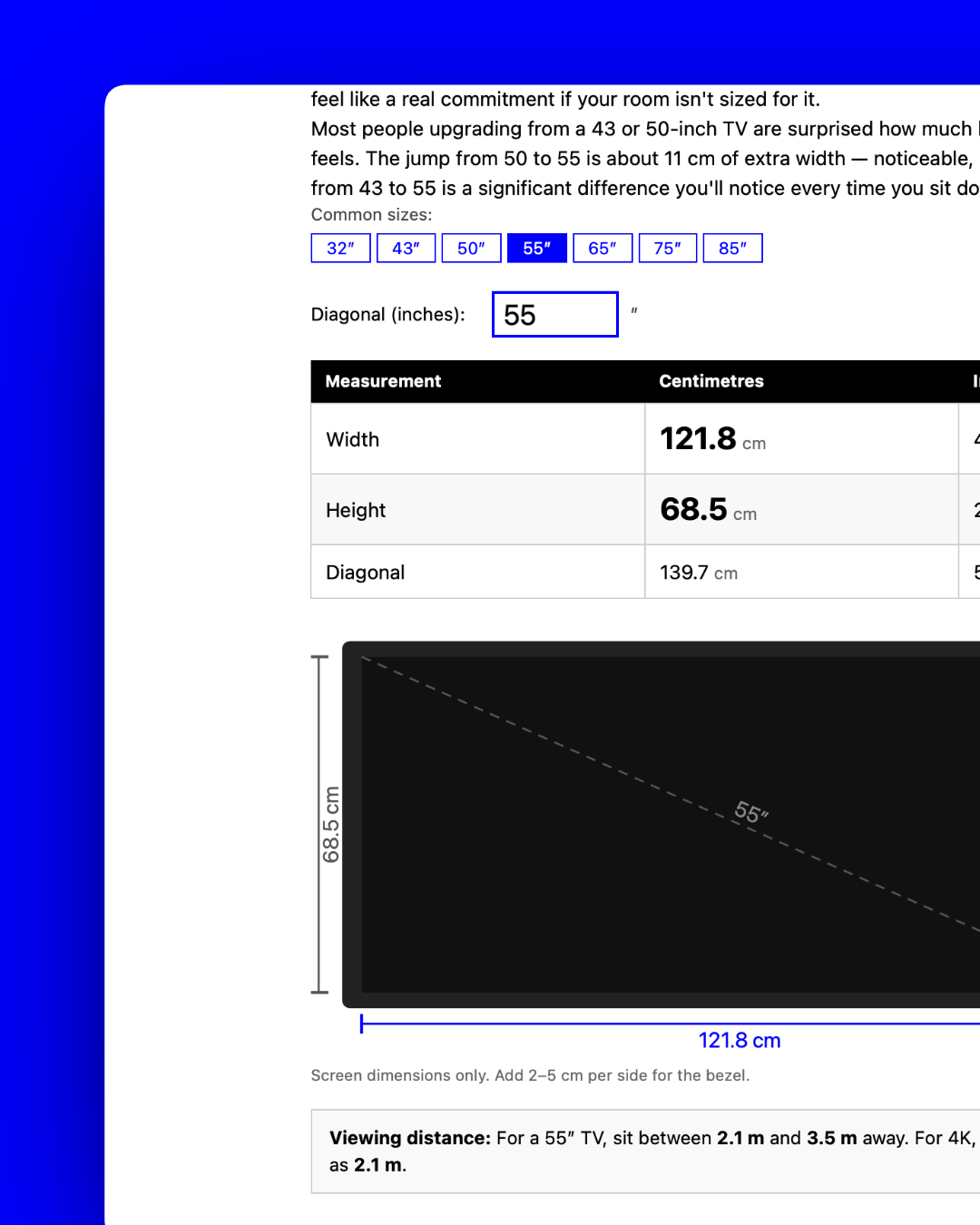
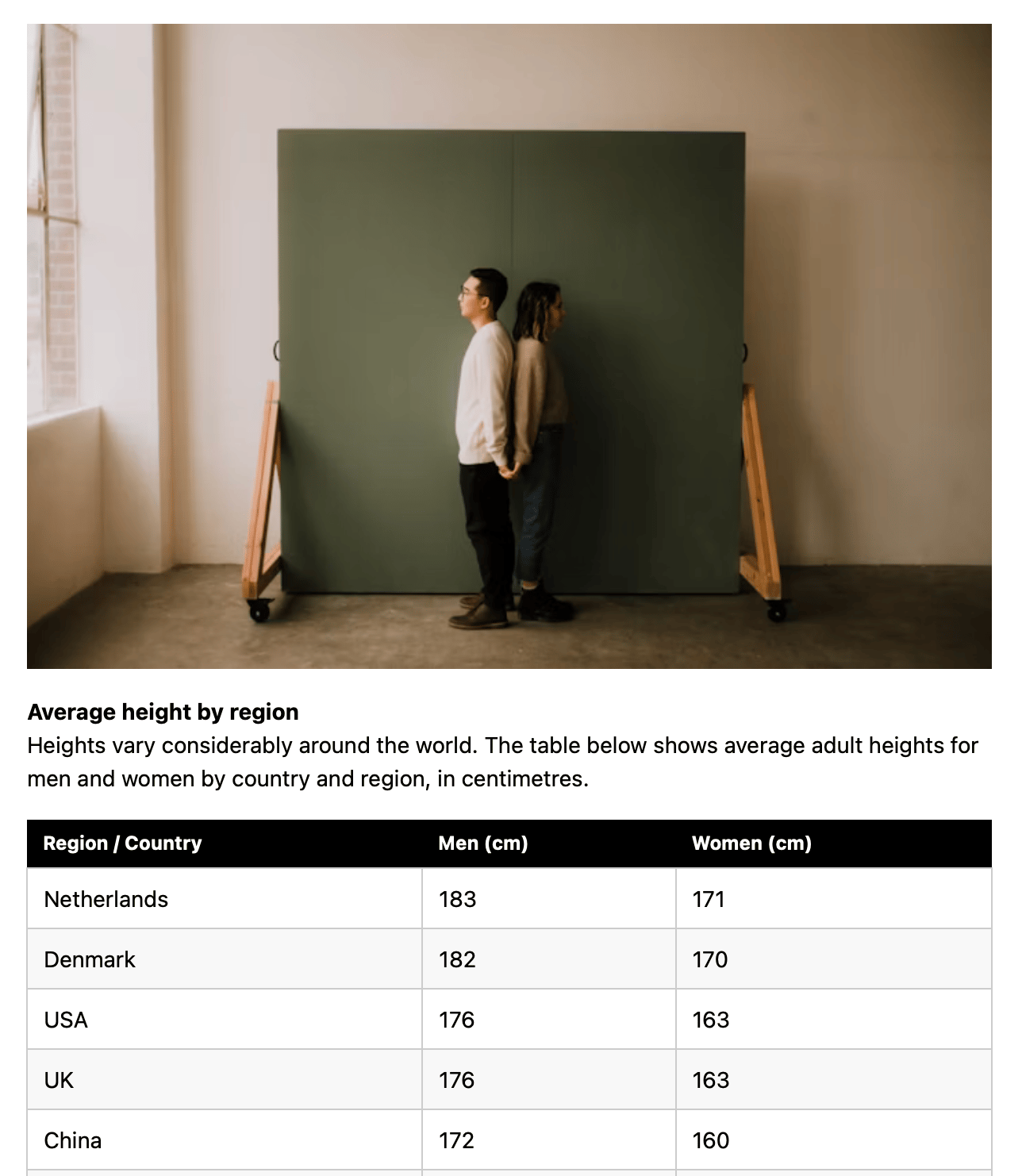
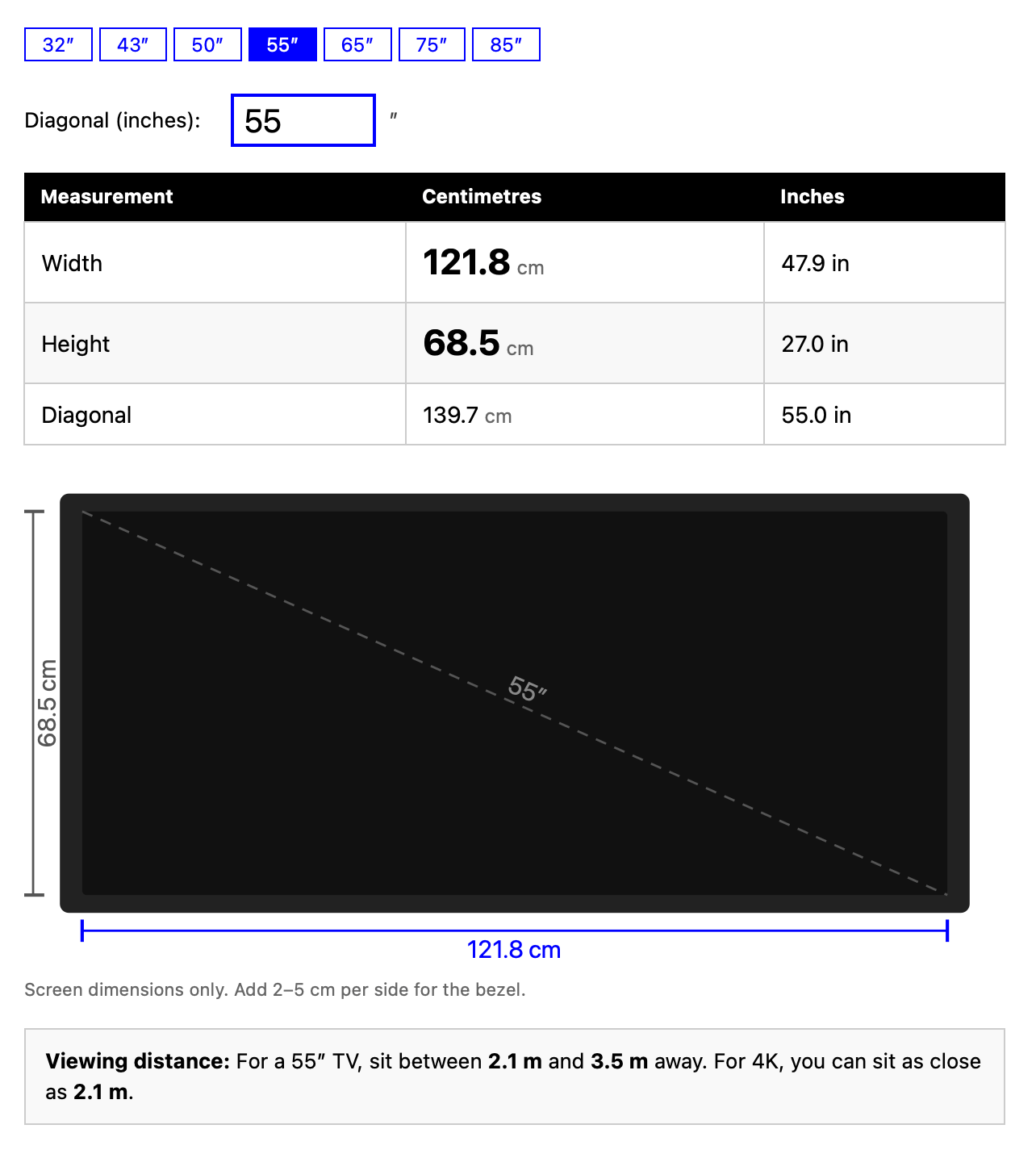
Unitwiz is a site full of small calculators and charts. TV sizes, cooking conversions, how big a 55-inch screen really is. Stuff like that. I started it because I was trying to work out exactly the tv-size, looked at the big calculator directories that rank for these queries, and noticed they make real money despite being genuinely ugly. The thought was the obvious one: if these can win, surely I can build something nicer and take a slice.
The calculators were never the interesting part. The interesting part was the agent that made them.
The pages themselves are deliberately plain, close to unstyled. That isn't laziness, it’s just me leaning on what the space looks like. Someone arrives from a search with one question, wants the number, and leaves. The tool is the design, and restraint was a design decision.
How the agent earns its keep
The engine is a GitHub Action on a weekly schedule, a Slack bot, and the Claude API, wired to my Google Search Console data and Google Trends.
- Every Sunday it pulls the numbers, finds the gaps between what people search for and what the site already covers, and ranks the opportunities.
- Then Larissa posts the shortlist. On "/build," Claude generates the calculator and its supporting content against a strict design system I'd defined up front: page structure, writing rules, SVG patterns, SEO conventions.
- The page ships to Cloudflare, the docs update, the roadmap ticks over.
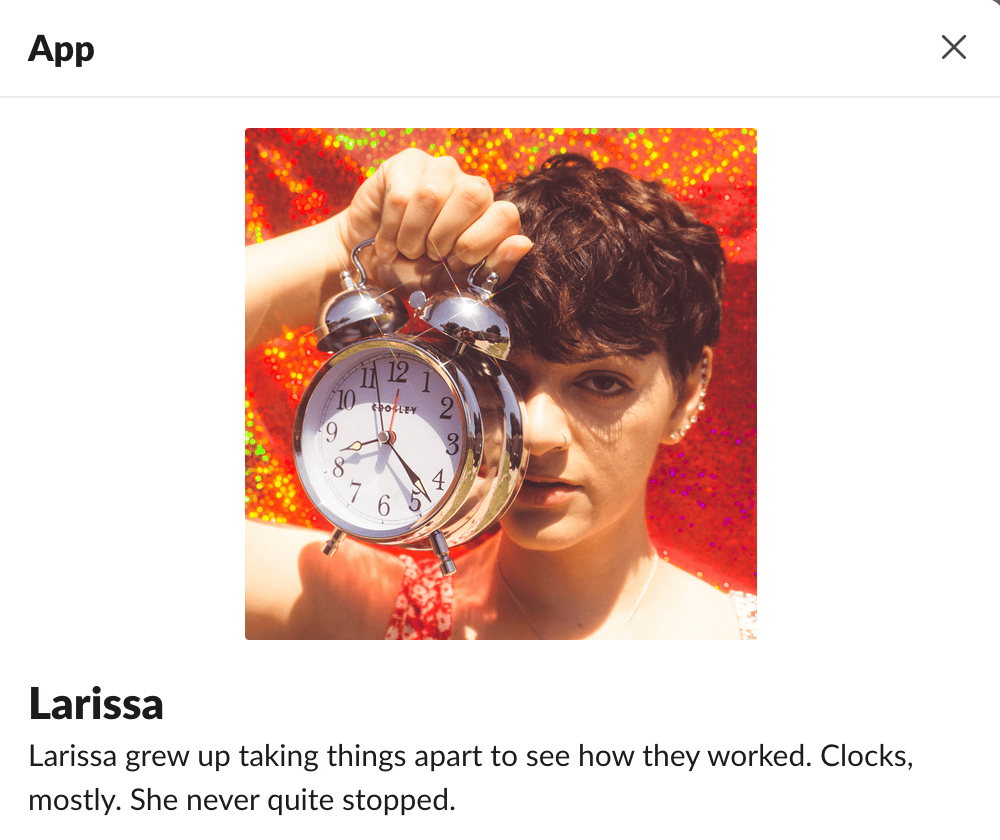
Larissa researches, reasons (admittedly in the simplest way), proposes, and builds.
20.000+
Google Search impressions
0%
Average CTR (ok, there were 5 clicks)
The machine worked. The market didn't.
Over about ten weeks the site collected roughly 20,000 impressions. Google saw the pages, indexed them, and put them in front of people 20,000 times. Of those, 5 turned into clicks. Of a thousand ranked queries, 999 sent me precisely no one.
The automation was flawless. The pipeline never broke. The pages were clean, fast, and correct. But I had built a perfect factory in a town with no road to it.
The calculator strongholds I’m up against aren't impressive by looks, but they've been accumulating authority for fifteen years, and every search anyone runs reinforces it. You don't out-build that. You'd have to out-last it, and I’m not about to spend fifteen years ranking for "6 foot in cm."
There's a bigger possibility I can't rule out, and it's less comfortable than just picking a hard market. Sites like these are basically enormous Q&A pages: a question goes in, a number comes out. That is precisely the kind of query Google now answers directly, without anyone needing to click anything at all. I may have built a very efficient agent for a way of finding things that the web is in the middle of leaving behind.
It’s alright it didn’t work. At least it made me believe in humanity again.
I could have left the machine running. Set it to "/build" on a loop and let it populate the internet with thousands of calculators nobody would ever find. But what's the point? It would just be handing money to Anthropic. I like them, but not that much, and maybe we don't need robots building pointless stuff.
The deeper thing is that I'm probably a bit relieved it's this hard. I went in assuming I could glance at someone's revenue model and clone a cut of it without breaking a sweat. I couldn't. And a world where you can, where any working product can be trivially copied the moment it's spotted, is a worse and messier world than this one.
I want to believe good products earn their place over time, and that being easy to make was never what made them good. I can't prove it. Making is under real pressure right now, and I'm not going to pretend I know how that resolves. But I'm still in love with the craft of building things, and will keep digging into what “craft” actually means right now.
The point of the experiment was never to replace the making. It was to find out how much further one person could take it.
Same, same but different.
The part I'll keep isn't the calculators or even the failure. It's where the work moved.
I didn't draw the pages. I wrote the rules the pages had to obey, and then I judged what deserved to exist. That's the same job I've done with design systems for years, pushed one step further upstream. When production is nearly free, making things stops being the scarce skill. Deciding what should be made is the whole job.
Deciding what should be made and how it’s made, is still the whole job. Which is roughly where I came in. The aim was never to remove myself, it was to build something solid enough to run on its own, so the only thing left in my hands was the decision that mattered most: what's worth making at all.
Building with AI: A PUBLISHING AGENT
What a weekend robot taught me about my own job. I wired up a Slack bot, the Claude API and a schedule. It researched, wrote and shipped pages on its own.
My favourite kind of design work is the kind that ends up running without me. Build the system well enough that it holds on its own, and it frees me to go after the next, bigger problem. This was an experiment in taking that as far as I could alone.
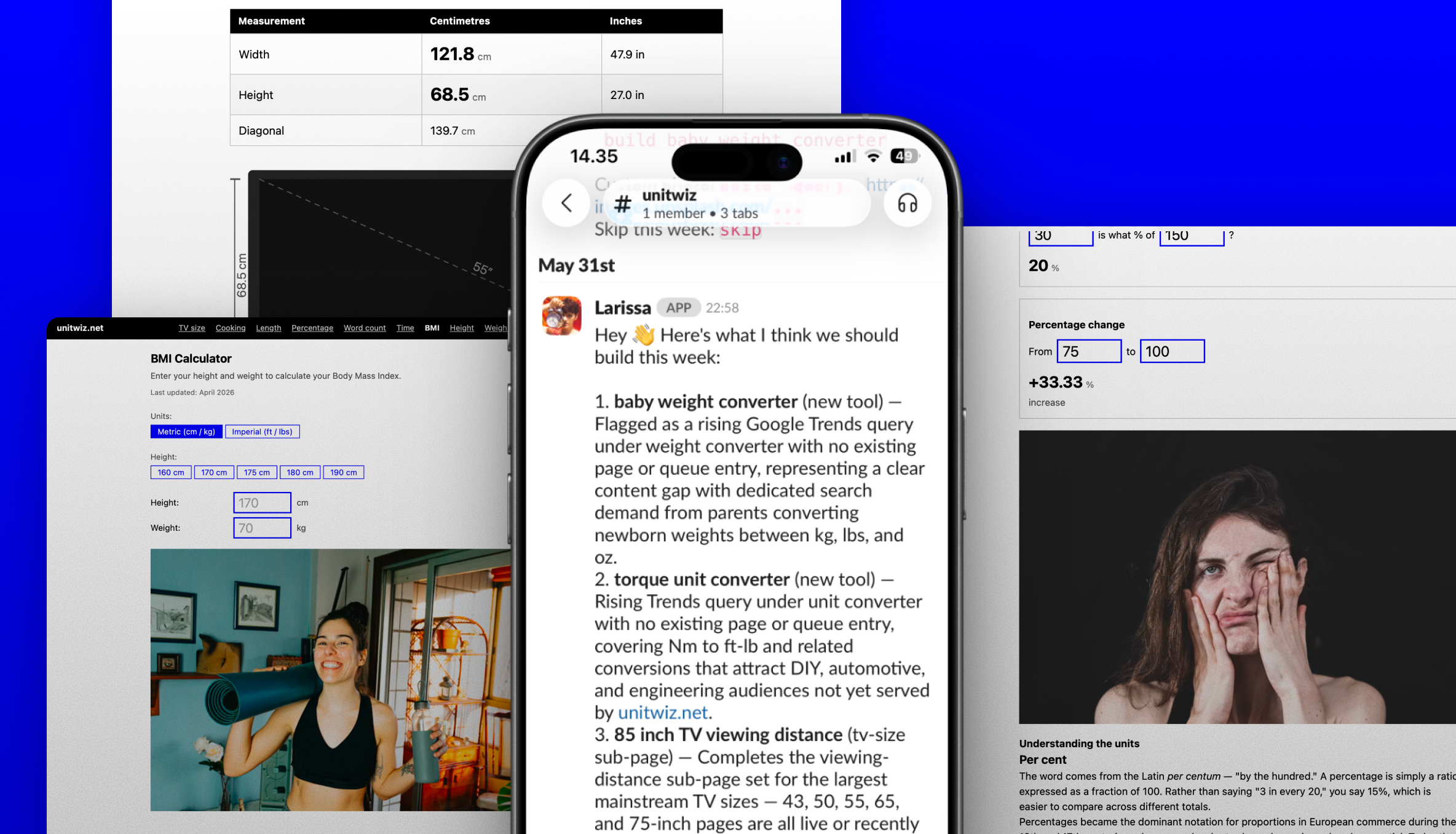
Every Sunday night, a Slack bot named Larissa told me what to build. She'd done her homework over the weekend, looked at the search data, and come back with three options and a short argument for each. Monday morning I'd read them, and reply with a single word.
“/build”
And then she’d get to work. New calculators written, illustrated, published, with the documentation and the roadmap updated to match. I hadn't done any production work. I'd approved a suggestion from a piece of software that had decided, on its own, what was worth doing.
That inversion is the whole project. For most of my career the direction of work ran one way: I decided what to make, then made it. Here the agent did the deciding. I just had to say yes. The agentic loop ran itself. The single word was mostly there so I stayed in control of what got spent, on tokens and on time.
Why build it at all?
My design approach has always aimed at the same thing: build the systems, the thinking and the culture solidly enough that the work keeps standing without me holding it up. Not so I'm not needed, but so I'm freed up for the bigger problems. Can I make it work that well? Maybe not a great career plan, but an admirable aspiration.
It's design-as-a-service, taken to a logical end. My output is never the screens. My output is the framework and the tools that enables the rest of the organisation to make flows, screens and experiences work. This experiment extends that thinking to a scale where I can carry out the whole project on my own and still have it mean something.
The experiment was to push the research, the prioritisation and the production all out of my hands, and find out what was left. What was left was judgment.
This is the full build-flow - from outside the machine room. I post in Slack during the week when I stumble on something that either was annoying (e.g. “I don’t get the US cup system in recipes”) or something that looks like a good idea or has market potential. Trying to mimick a reality, Larissa of course has a roadmap, she pairs the requests and mindless braindumps from the week gone by with simple trend research, and a look in Google Search Console data for the site to see if anything particular is rising.
It's just ugly calculators
Unitwiz is a site full of small calculators and charts. TV sizes, cooking conversions, how big a 55-inch screen really is. Stuff like that. I started it because I was trying to work out exactly the tv-size, looked at the big calculator directories that rank for these queries, and noticed they make real money despite being genuinely ugly. The thought was the obvious one: if these can win, surely I can build something nicer and take a slice.
The calculators were never the interesting part. The interesting part was the agent that made them.
The pages themselves are deliberately plain, close to unstyled. That isn't laziness, it’s just me leaning on what the space looks like. Someone arrives from a search with one question, wants the number, and leaves. The tool is the design, and restraint was a design decision.
How the agent earns its keep
The engine is a GitHub Action on a weekly schedule, a Slack bot, and the Claude API, wired to my Google Search Console data and Google Trends.
- Every Sunday it pulls the numbers, finds the gaps between what people search for and what the site already covers, and ranks the opportunities.
- Then Larissa posts the shortlist. On "/build," Claude generates the calculator and its supporting content against a strict design system I'd defined up front: page structure, writing rules, SVG patterns, SEO conventions.
- The page ships to Cloudflare, the docs update, the roadmap ticks over.
Larissa researches, reasons (admittedly in the simplest way), proposes, and builds.
20.000+
Google Search impressions
0%
Average CTR (ok, there were 5 clicks)
The machine worked. The market didn't.
Over about ten weeks the site collected roughly 20,000 impressions. Google saw the pages, indexed them, and put them in front of people 20,000 times. Of those, 5 turned into clicks. Of a thousand ranked queries, 999 sent me precisely no one.
The automation was flawless. The pipeline never broke. The pages were clean, fast, and correct. But I had built a perfect factory in a town with no road to it.
The calculator strongholds I’m up against aren't impressive by looks, but they've been accumulating authority for fifteen years, and every search anyone runs reinforces it. You don't out-build that. You'd have to out-last it, and I’m not about to spend fifteen years ranking for "6 foot in cm."
There's a bigger possibility I can't rule out, and it's less comfortable than just picking a hard market. Sites like these are basically enormous Q&A pages: a question goes in, a number comes out. That is precisely the kind of query Google now answers directly, without anyone needing to click anything at all. I may have built a very efficient agent for a way of finding things that the web is in the middle of leaving behind.
It’s alright it didn’t work. At least it made me believe in humanity again.
I could have left the machine running. Set it to "/build" on a loop and let it populate the internet with thousands of calculators nobody would ever find. But what's the point? It would just be handing money to Anthropic. I like them, but not that much, and maybe we don't need robots building pointless stuff.
The deeper thing is that I'm probably a bit relieved it's this hard. I went in assuming I could glance at someone's revenue model and clone a cut of it without breaking a sweat. I couldn't. And a world where you can, where any working product can be trivially copied the moment it's spotted, is a worse and messier world than this one.
I want to believe good products earn their place over time, and that being easy to make was never what made them good. I can't prove it. Making is under real pressure right now, and I'm not going to pretend I know how that resolves. But I'm still in love with the craft of building things, and will keep digging into what “craft” actually means right now.
The point of the experiment was never to replace the making. It was to find out how much further one person could take it.
Same, same but different.
The part I'll keep isn't the calculators or even the failure. It's where the work moved.
I didn't draw the pages. I wrote the rules the pages had to obey, and then I judged what deserved to exist. That's the same job I've done with design systems for years, pushed one step further upstream. When production is nearly free, making things stops being the scarce skill. Deciding what should be made is the whole job.
Deciding what should be made and how it’s made, is still the whole job. Which is roughly where I came in. The aim was never to remove myself, it was to build something solid enough to run on its own, so the only thing left in my hands was the decision that mattered most: what's worth making at all.
Building with AI: A PUBLISHING AGENT
What a weekend robot taught me about my own job. I wired up a Slack bot, the Claude API and a schedule. It researched, wrote and shipped pages on its own.
My favourite kind of design work is the kind that ends up running without me. Build the system well enough that it holds on its own, and it frees me to go after the next, bigger problem. This was an experiment in taking that as far as I could alone.
Every Sunday night, a Slack bot named Larissa told me what to build. She'd done her homework over the weekend, looked at the search data, and come back with three options and a short argument for each. Monday morning I'd read them, and reply with a single word.
“/build”
And then she’d get to work. New calculators written, illustrated, published, with the documentation and the roadmap updated to match. I hadn't done any production work. I'd approved a suggestion from a piece of software that had decided, on its own, what was worth doing.
That inversion is the whole project. For most of my career the direction of work ran one way: I decided what to make, then made it. Here the agent did the deciding. I just had to say yes. The agentic loop ran itself. The single word was mostly there so I stayed in control of what got spent, on tokens and on time.
Why build it at all?
My design approach has always aimed at the same thing: build the systems, the thinking and the culture solidly enough that the work keeps standing without me holding it up. Not so I'm not needed, but so I'm freed up for the bigger problems. Can I make it work that well? Maybe not a great career plan, but an admirable aspiration.
It's design-as-a-service, taken to a logical end. My output is never the screens. My output is the framework and the tools that enables the rest of the organisation to make flows, screens and experiences work. This experiment extends that thinking to a scale where I can carry out the whole project on my own and still have it mean something.
The experiment was to push the research, the prioritisation and the production all out of my hands, and find out what was left. What was left was judgment.
This is the full build-flow - from outside the machine room. I post in Slack during the week when I stumble on something that either was annoying (e.g. “I don’t get the US cup system in recipes”) or something that looks like a good idea or has market potential. Trying to mimick a reality, Larissa of course has a roadmap, she pairs the requests and mindless braindumps from the week gone by with simple trend research, and a look in Google Search Console data for the site to see if anything particular is rising.
It's just ugly calculators
Unitwiz is a site full of small calculators and charts. TV sizes, cooking conversions, how big a 55-inch screen really is. Stuff like that. I started it because I was trying to work out exactly the tv-size, looked at the big calculator directories that rank for these queries, and noticed they make real money despite being genuinely ugly. The thought was the obvious one: if these can win, surely I can build something nicer and take a slice.
The calculators were never the interesting part. The interesting part was the agent that made them.
The pages themselves are deliberately plain, close to unstyled. That isn't laziness, it’s just me leaning on what the space looks like. Someone arrives from a search with one question, wants the number, and leaves. The tool is the design, and restraint was a design decision.
How the agent earns its keep
The engine is a GitHub Action on a weekly schedule, a Slack bot, and the Claude API, wired to my Google Search Console data and Google Trends.
- Every Sunday it pulls the numbers, finds the gaps between what people search for and what the site already covers, and ranks the opportunities.
- Then Larissa posts the shortlist. On "/build," Claude generates the calculator and its supporting content against a strict design system I'd defined up front: page structure, writing rules, SVG patterns, SEO conventions.
- The page ships to Cloudflare, the docs update, the roadmap ticks over.
Larissa researches, reasons (admittedly in the simplest way), proposes, and builds.
The machine worked. The market didn't.
Over about ten weeks the site collected roughly 20,000 impressions. Google saw the pages, indexed them, and put them in front of people 20,000 times. Of those, 5 turned into clicks. Of a thousand ranked queries, 999 sent me precisely no one.
The automation was flawless. The pipeline never broke. The pages were clean, fast, and correct. But I had built a perfect factory in a town with no road to it.
The calculator strongholds I’m up against aren't impressive by looks, but they've been accumulating authority for fifteen years, and every search anyone runs reinforces it. You don't out-build that. You'd have to out-last it, and I’m not about to spend fifteen years ranking for "6 foot in cm."
There's a bigger possibility I can't rule out, and it's less comfortable than just picking a hard market. Sites like these are basically enormous Q&A pages: a question goes in, a number comes out. That is precisely the kind of query Google now answers directly, without anyone needing to click anything at all. I may have built a very efficient agent for a way of finding things that the web is in the middle of leaving behind.
Metrics
20.000+
Google Search impressions
0%
Average CTR (ok, there were 5 clicks)
It’s alright it didn’t work. At least it made me believe in humanity again.
I could have left the machine running. Set it to "/build" on a loop and let it populate the internet with thousands of calculators nobody would ever find. But what's the point? It would just be handing money to Anthropic. I like them, but not that much, and maybe we don't need robots building pointless stuff.
The deeper thing is that I'm probably a bit relieved it's this hard. I went in assuming I could glance at someone's revenue model and clone a cut of it without breaking a sweat. I couldn't. And a world where you can, where any working product can be trivially copied the moment it's spotted, is a worse and messier world than this one.
I want to believe good products earn their place over time, and that being easy to make was never what made them good. I can't prove it, because crap is still coming through the cracks. Making is under real pressure right now, and I'm not pretending to know how that resolves. But I'm still in love with the craft of making things, and that's exactly why I went this far into the tools, not the other way around.
Same, same but different.
The part I'll keep isn't the calculators or even the failure. It's where the work moved.
I didn't draw all the pages. I wrote the rules the pages had to obey, and then I let the agent run. That's the same job I've done for decades - amplifying the designer’s choices to let the rest of the organisation to produce better and produce more qualified. When production is nearly free, this gets even more important.
Deciding what should be made and how it’s made, is still the whole job. Which is roughly where I came in. The aim was never to remove myself, it was to build something solid enough to run on its own, so the only thing left in my hands was the decision that mattered most: what's worth making at all.